
Hoi An Flood Diary: Eight Days of Survival (Part 1: Days 1–6)
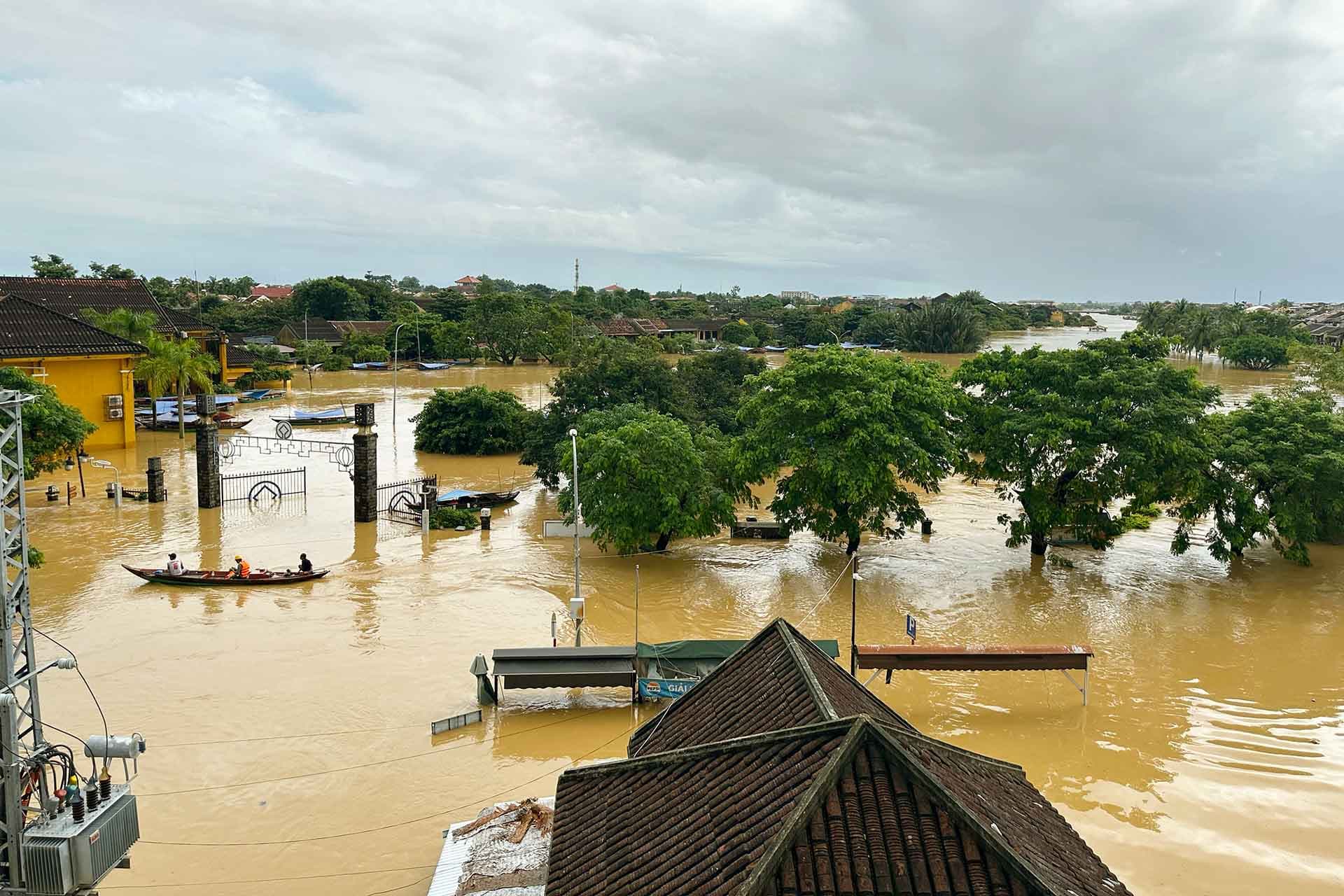
In late October 2025, central Vietnam faced one of its most devastating floods in decades. The Thu Bồn River in Hoi An rose higher than it had since 1964, submerging homes, shops, and entire streets under muddy water.
What started as a normal morning for me turned into eight unforgettable days of survival, silence, and rediscovering what truly matters.
This is my diary: a story of living through the flood in Hoi An, side by side with strangers who became friends, and finding light even when the power went out.
When life suddenly strips away the comforts we often overlook...
We often see images online or hear news about natural disasters happening around the world. But when you become one of those living through it, everything changes.
Those eight days of flooding (twice) in Hoi An taught me more than I could have imagined. When life takes away the things we depend on daily, like electricity, clean water, even the simplest supplies...it humbles you. It's definitely humbled me.
Day 1: Incoming Flood Warning
5:30 a.m. Woke up as usual. Morning routine: stretching, journaling, checked. “Okay, now fried eggs for breakfast,” I thought to myself.
7:00 a.m. The phone rang. “Who would call me this early?” It was Nam, the owner of the Ivy Hotel. “Hey, give me your bike key. We’ve got to move it somewhere higher.”
“What?” I replied, still half confused.
As I stepped out of my room to hand him the key, I saw the hotel staff, tables, chairs, and scaffolding in hand, moving things quickly with sweat dripping down their faces. “Trinh, pack your stuff in case we need to move you upstairs,” one of them said. “Flood’s coming. We don’t know how high it’ll go, but we have to prepare now.”
I started packing, not really understanding how serious this flooding thing would be. I didn’t know what to expect, but at that point, I decided to listen and do whatever they told me without second-guessing.
The water rose faster than I could have imagined. Within just a few hours, the floodwater had reached my knees (I’m 1.6 m tall). Guests from nearby hotels were evacuating.
According to the locals, the last time a flood warning was issued was in 2017, and the water that entered the hotel then was approximately 40 cm (roughly one metre out on the street). It had dried out in a day or two.
Everyone left except Uncle Manh (in Vietnamese culture, we call those younger than our father chú, meaning “uncle”), Robert, an American in his 70s, and me.
By the afternoon, I started informing my family and friends about the situation.
Then, phuut. 6:30 p.m. Power cut. Just me and my thoughts, alone in the dark.
Day 2: Rescue the Dragon Fruits and the God Altar
5:00 a.m. Woke up early, checked the floodwater from the balcony, and that’s when this diary truly began.
I went downstairs to check on Uncle Manh and Robert. The floodwater had entered the ground floor. There, I saw three dragon fruits floating around the Ông Địa (Earth God) and Ông Thần Tài (God of Wealth) altar.
I asked chú Manh if we could take them (in Vietnamese culture, you always ask permission before touching offerings, even in a crisis). But when you’re in survival mode, you do what you have to do.
So, I quickly changed into my gym outfit and dived into the muddy water. At that point, it had reached my waist. The water was cold, sticky, and heavy with mud.
As we expected the flood to rise again, chú Manh asked me to rescue the altar too, as it was important for the hotel’s spirit. So I did.
The rest of the day passed in a rhythm: aeroplane mode on, writing, reading, stretching, checking the water, repeat.
Rain came and went. As night fell, Hoi An went completely quiet. Everything was submerged in darkness. Strangely, I enjoyed this tranquil moment. Thoughts kept flowing, and I just let them.
Day 3: Supplies from the Hotel Owner
5:00 a.m. Woke up and checked the water. It looked slightly lower than the day before.
“Maybe today or tomorrow it’ll drain out,” predicted Uncle Manh. For some reason, I doubted that. The rain hadn’t really stopped.
We decided to rescue a gas tank and some cooking equipment from the flooded kitchen so we could boil water for coffee and, most importantly, for instant noodles.
Later that day, Nam, the Ivy hotel’s owner, arrived in a small boat and threw us a bag of supplies from the roof. I climbed over the balcony railing, slowly made my way across the roof, and picked it up. Inside were food and, thankfully, a power bank.
That meal of plain white rice and canned tuna became one of the best we’d ever had. With a cup of hot coffee, even if it was instant, it felt like heaven.
The rest of the day continued with my familiar routine: writing, reading, stretching, checking the water, and repeating. We went to bed happier that evening, hoping the water would finally start to go down.
Day 4: Knock Knock, No More Running Water
Around midnight: Bam bam. “Trinh ơi!” Uncle Manh knocked repeatedly on my door.
“Yes?” I replied, half-asleep. “Come down now,” he said, his voice tight with worry.
We looked down from the stairs. The water had risen more than a metre higher than the night before. There wasn’t much we could do, so I went back to bed. But not Uncle Manh, as I found out in the morning.
He stayed up, wading through the water to rescue more items, loyal and responsible, doing his best to protect the hotel. I truly admired that.
When daylight arrived, I went to the balcony to check the water level properly from the third floor.
Wow. The hotel sign across the street, the one I’d been using to measure the water level, was almost completely submerged.
That day, the Thu Bồn River peaked at around 5.7 metres, officially surpassing the historic 1964 flood record of 5.48 metres, the highest level ever recorded in Hoi An’s modern history.
I saw neighbours tossing their soaked mattresses off the roofs into the flood stream. It broke my heart. Where would all this waste go once the water dried out? Who would clean it up?
Between moments of reflection, reading, and writing, I’d catch glimpses of neighbours gathered on their rooftops, “chilling”. We’d wave at each other from a distance, those small, comforting gestures that made me smile. We were in this together.
At 1:30 p.m., Uncle Manh shouted with joy, “Look! The water’s receding!” And indeed, we could see a wet line marking the yellow Indochina-style wall across the street. Hope returned.
That evening, the rain stopped. I took the chance to sit quietly on the balcony, surrounded by total darkness. It had been days without the sound of the fridge, no street noise, no tourists, just the occasional flash of patrol boat lights and the gentle ripple of the flood and the constant rain.
Day 5 and Day 6: The Clean-Up Begins
4:00 a.m. Woke up to the sound of neighbours chatting. “Why are they up so early?” I wondered.
It was still dark. I could only see their flashlights moving around. Wait. People were cleaning!
The fog was thick that morning. I went back to sleep for a few more hours, feeling hopeful.
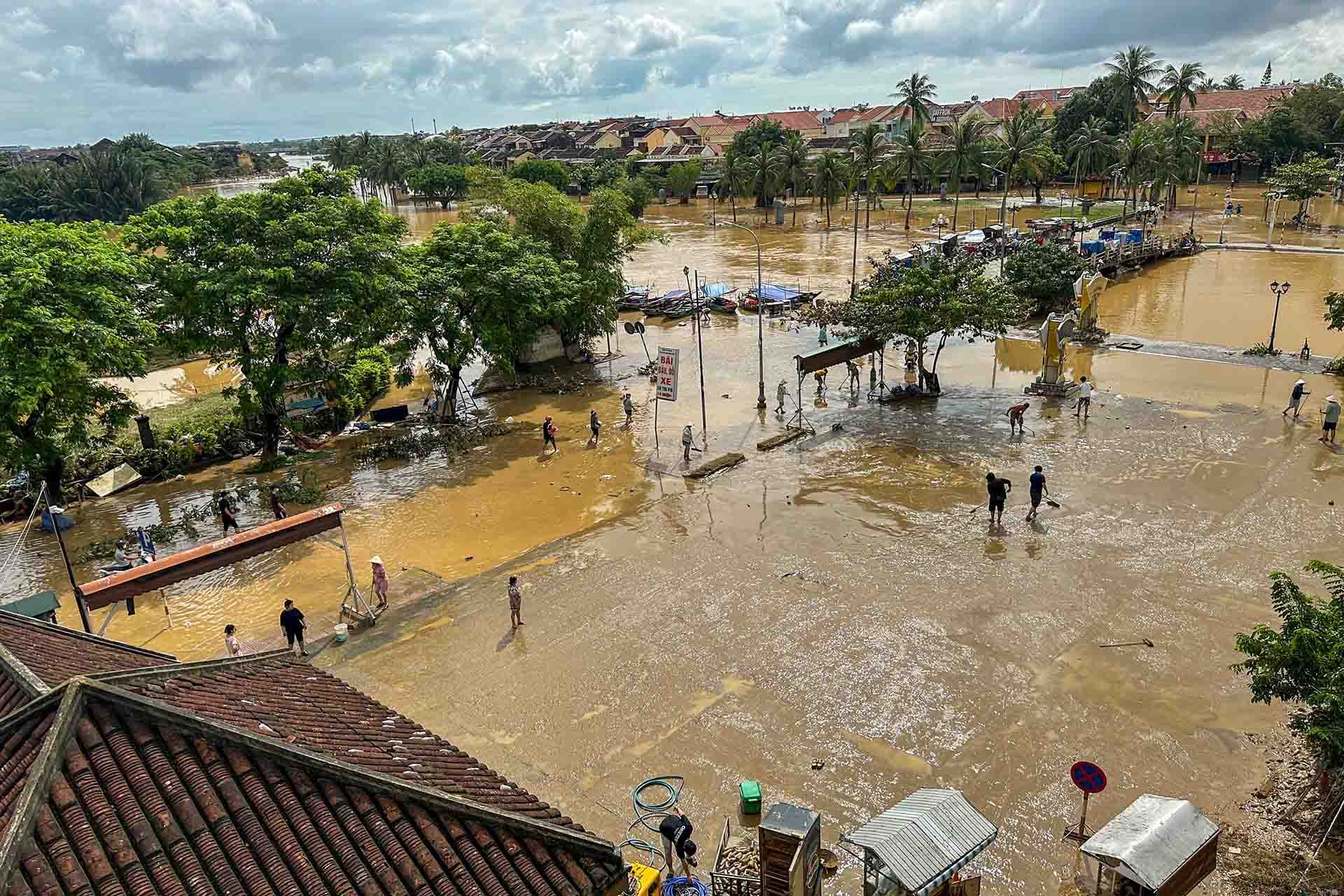
6:00 a.m. The neighbour’s hotel sign was fully visible again. People were already on the streets, sweeping mud and debris.
I hurried downstairs, so happy to see the familiar faces of the Ivy hotel people. The clean-up had begun. Two long days of scrubbing, scooping, and sweeping mud followed.
We still didn’t have electricity, so we used floodwater to wash the thick, sticky mud first, as locals say clean water should only be used after. Apparently, it’s because floodwater itself dissolves the sediment better before you rinse everything again with clean water.
The amount of damage was overwhelming. In total, over 22,000 homes were submerged across Quảng Nam Province, and nearly 100,000 people lost power.
As the sun returned and the streets of Hoi An slowly came back to life, I thought the worst was finally over. People were laughing again. Shops began reopening. There was light, warmth, and a strange sense of gratitude in the air.
For the first time in days, I could breathe easily.
Little did I know, nature wasn’t done with us yet.
(To be continued…). Part 2.
Related Articles
2025 in Review: From Goals to Intentions
A 2025 year in review on intention setting, living abroad, career transitions, and self-discovery across Europe and Vietnam.
Hoi An Flood Diary: The Second Wave (Part 2: Days 7–9)
The flood returned to Hoi An. What followed was a quiet story of patience, courage, and humanity shining through the storm.
Coping with Reverse Culture Shock. Coming Home After Living Abroad
Feeling lost after returning home from abroad? Discover how to navigate reverse culture shock and find peace and balance again.